Mourning the Beit HaMikdash
Why are we still mourning the Temple thousands of years later?
By Danielle Fisher and Ari Levisohn | 22 July 2024 | 5 Minute Read
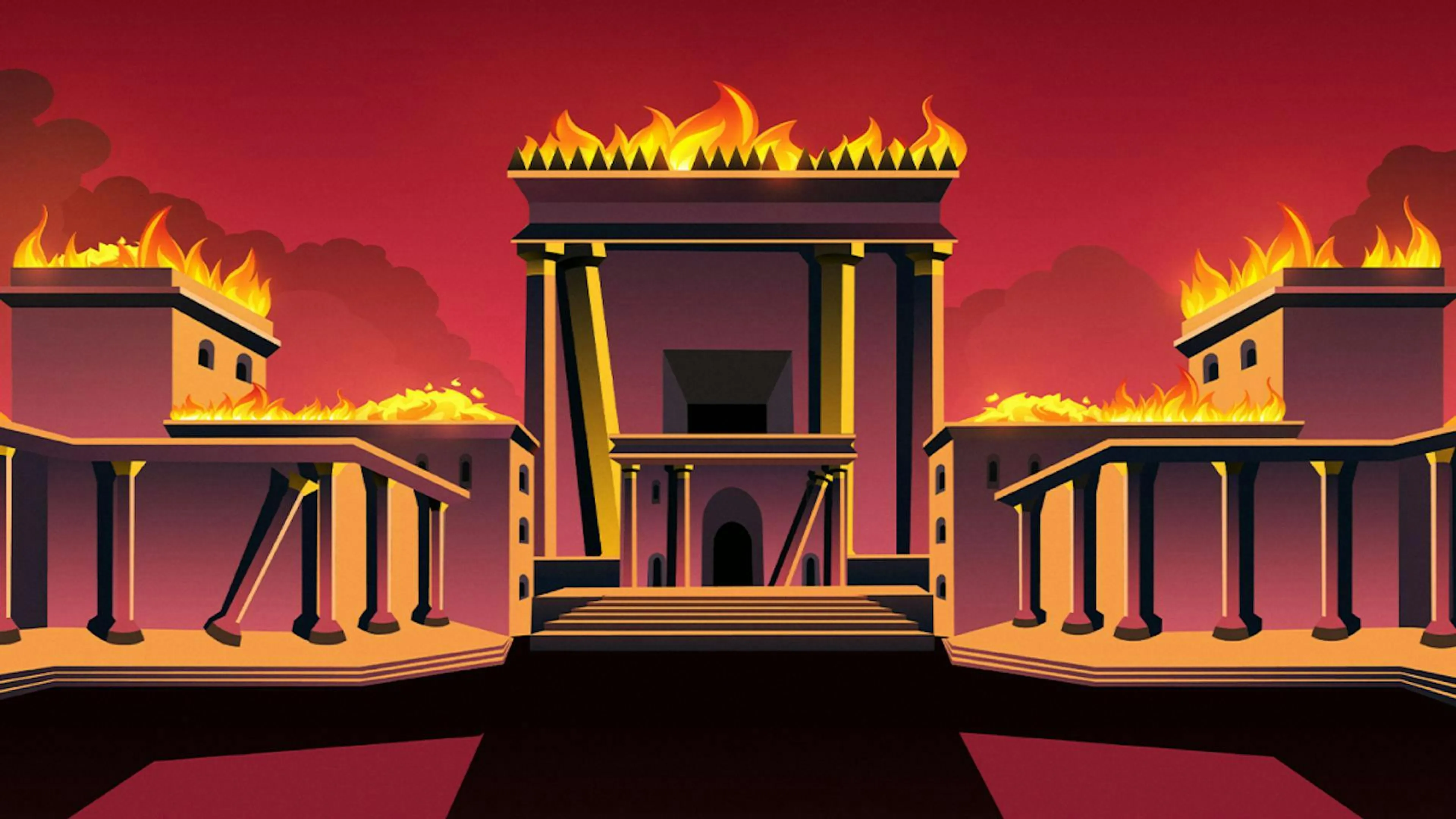
Why Mourn a Building?
Every year, when Tisha B’Av begins, we go to synagogue, dim the lights, and prepare ourselves for a dismal 25 hours. We sit on the floor or on low chairs. We do not greet one another. We refuse to eat. We spend the day crying over what we’ve lost, begging G-d to bring us back to the good ole’ days. But what we’ve lost is…a building?!
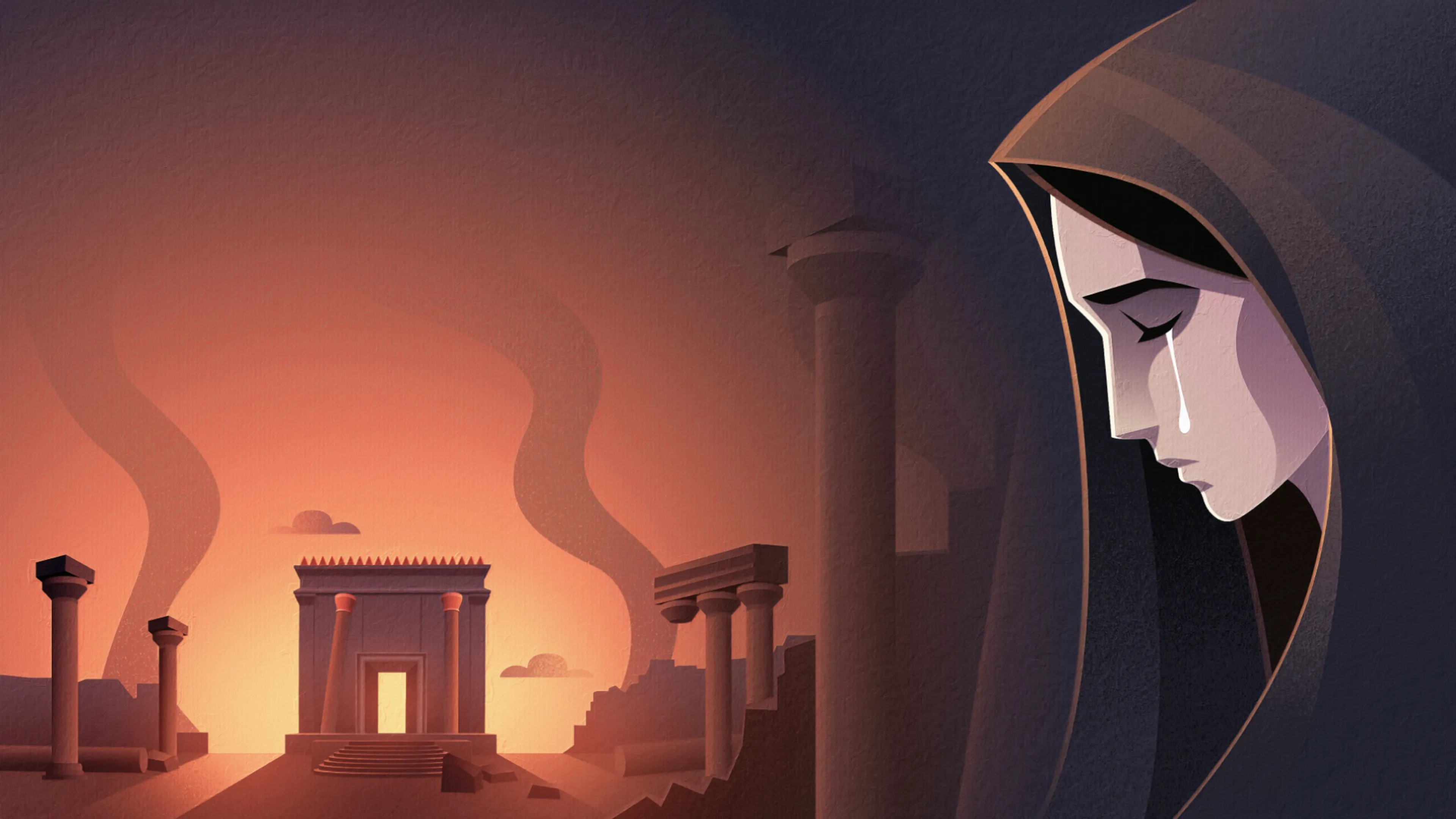
Our Tisha B’Av mourning centers around the destruction of the Beit HaMikdash, the Holy Temple in Jerusalem. But in a modern world, when many of us may feel wary about returning to a time of animal sacrifices and annual pilgrimages to Jerusalem, connecting to the pain of losing the Temple can be quite a challenge. What made the Beit HaMikdash so significant that, thousands of years later, we are still mourning its destruction?
Historical Context
Let’s begin by understanding a little more about the Temple. When we refer to the Beit HaMikdash, we’re actually talking about two different structures: the First Temple and the Second Temple. Both were built on the same site, the Temple Mount in Jerusalem, one after the other, and both were destroyed on the 9th of Av, centuries apart.
The First Temple (957 BCE-586 BCE)
The First Temple was built by King Solomon around 957 BCE. The Temple perched atop Mount Moriah, the holy site where thousands of years earlier, Abraham passed G-d’s test of the binding of his son Isaac, and where Jacob dreamed of angels. Building the Temple was a major feat that required tens of thousands of workers and materials from across the land. It was a massive structure, consisting of multiple gates and various chambers where the Kohanim, or priests, would perform sacrifices. At its center was the Holy of Holies, the most sacred area consisting of the cherubim and the Ark of the Covenant, where only the High Priest could enter once a year on Yom Kippur. The Temple took seven years to complete, and King Solomon celebrated its completion with inaugural celebrations that lasted for an entire week. Solomon’s Temple stood for 400 years, until the Babylonians, led by Nebuchadnezzar, destroyed it on the 9th of Av in 586 BCE, exiling thousands of Jews to Babylon and carting off the Temple’s holy vessels.
The Second Temple (516 BCE-70 CE)
Throughout exile in Babylon, the Jewish people maintained hope of returning to Jerusalem and rebuilding the Temple. The prophet Jeremiah had predicted that G-d would restore the Jewish people after 70 years of exile (Jeremiah 29:10). And in fact, 50 years after the destruction of the First Temple, the Persian Empire conquered the Babylonians, and King Cyrus authorized the Temple’s rebuilding. Nearly 50,000 Jews flocked to the land of Israel to begin the rebuilding, led by Zerubbabel, a descendant of the House of David and governor of a Persian province. Though construction paused amidst interference by the Samaritans, it resumed again 20 years later under the approval of King Darius (believed to be the son of Queen Esther). Its completion aligned with Jeremiah’s prophecy, occurring between 516 BCE and 350 BCE. Great celebrations ensued upon the Temple’s rededication, and sacrificial worship resumed. However, the Second Temple remained a spiritual shadow of the First. While the Holy of Holies was restored, it remained empty, devoid of the Ark of Covenant and the holy cherubim. The Second Temple was refurbished by the Hasmoneans in 200 BCE (yes, the Hasmoneans of the Hanukkah story), and expanded by King Herod in 18 CE. It stood between 400-600 years, until the Romans destroyed it—again on the 9th of Av, this time in 70 CE.
More Than Just a Building
To understand why we continue to mourn its loss, we have to understand: what did we really lose when we lost the Beit HaMikdash? The Beit HaMikdash was not just a place of worship; it was believed to be the dwelling place of the Shekhinah, God's presence on earth. It was where the Jewish people went when they erred to offer up sacrifices and bask in G-d’s forgiveness; where they flocked on Sukkot, Shavuot, and Passover to experience G-d’s closeness; where they waited with bated breath on Yom Kippur for G-d’s acceptance of their atonement. The Temple was a physical manifestation of G-d’s love, G-d’s blessings, G-d’s forgiveness. And then, all of a sudden…it was gone.
For us modern-day Jews, who have never experienced life with the Beit HaMikdash, it can be hard to truly appreciate what we are missing. Sacrifices have been replaced with prayers. We have beautiful synagogues. We lead meaningful religious lives. Even more so, the idea of a physical place where G-d resides may seem almost heretical. If G-d is everywhere, why does G-d need a house? Was the Temple really just for our own comfort and assurance, a convenient tool to help us imagine that we had some tangible contact with the Almighty?
The Torah suggests that the Temple was so much more than just a “dollhouse” built for our own benefit. Because the Temple had a precursor, the Mishkan. The Torah spends chapter upon chapter detailing the Mishkan’s design and construction in excruciating detail. It’s clear that there is something extraordinary—something divine— about this building. If we can understand some of the deeper spiritual mysteries behind the Mishkan, then we just might be able to unlock the true significance of the Temple—and the reason why, thousands of years later, we still mourn the Temple’s destruction.
In his video series, “How Am I Supposed to Appreciate the Loss of the Beit HaMikdash?” Rabbi Fohrman explores what we really lost when we lost the Temple– and why that loss includes so much more than just a building.
Why do we mourn a building?
Browse the Whole Tisha B'Av Collection










More Tisha B'Av Content
- Tisha B'Av Home
- Tisha B'Av 101
- Tisha B'Av for Kids
- Top 5 Tisha B'Av Videos
- Tisha B'Av & The Spies
- Tisha B'Av Torah & Haftarah Readings
- Understanding Kinot
- Eicha
- Book of Iyov Explained
- Is Tish b'Av a Yom Tov
- Tisha B'av Inspiration
- Tisha B'av Shiurim (lectures)
- Finding Meaning in Tisha B'av
- Tisha B'av after October 7th
- Tisha B'av and the Messiah
- Gemara for Tisha Bav
- Why do we Mourn on Tisha B'av?
What is Aleph Beta?
Aleph Beta is a unique kind of Torah library. Led by our founder, Rabbi David Fohrman, we are dedicated to high-level, textual Torah learning for adults that is intellectually and spiritually sophisticated, that enlivens your Jewish practice and helps you forge a deeper connection to God. Whether you’ve been learning in yeshiva for years or you’re just beginning your Torah journey, you’re sure to find something meaningful and surprising waiting for you here.
Browse our library of over 1,000 beautifully produced animated videos, podcasts, deep dive courses, and printable guides. Topics include the weekly parsha, Jewish holidays & fast days, laws & mitzvot, prayers, relationships, big philosophical ideas and more. Have something to say at the Shabbos table that will amaze your family and guests and bring deep meaning into their lives.